
JW_DLM
JW_DLM represents the next step in John White’s frequency research, building on the foundations of Molecular Weight and RRM. By using a high-resolution discrete lattice model, it aims to capture finer details of atomic and molecular structures and derive more precise, absolute frequencies without relying on a common scaling coefficient.
Project Background
JW_DLM is not an independent project that appeared suddenly. It is the result of the gradual evolution of John’s frequency research.
In the Molecular Weight project, John used the monoisotopic mass of a substance together with a multiplier to calculate usable frequency programs for drugs, supplements, and other molecules. However, this method is based on the overall mass of a substance and cannot fully express the complexity of its internal structure.
John later advanced to JW_RRM. This method analyzes the energy patterns of molecules and proteins, identifies characteristic peaks, and uses these patterns to explore possible matches between targets and substances.
The current RRM method is already highly developed. It has progressed from producing one frequency to producing two frequencies, and then multiple characteristic frequencies. Compared with the Molecular Weight method, it provides a much more detailed representation of a substance.
John did not stop there.
RRM is highly effective at recognizing energy patterns, but it mainly expresses the relative relationships among characteristic peaks. The published RRM frequencies are produced using a common scaling coefficient. The method can show the relationship of one peak to another, but it does not provide the absolute frequency values that John seeks.
John compares this to mapping a mountain range. RRM can show the outlines of the mountains, the positions of the peaks and valleys, and their relative heights. However, it cannot provide the exact height of every peak.
To achieve greater resolution and derive absolute frequencies without applying a common scaling coefficient, John rebuilt the calculation method on the foundation of RRM and developed JW_DLM, the JW Discrete Lattice Model.
The central motivation behind JW_DLM is John’s continuing pursuit of increasingly precise frequency expression and his desire to reduce the gap between a computational model and the true complexity of a substance.
JW_DLM in One Minute
JW_DLM is a high resolution method developed by John White for deriving substance frequencies.
It uses a discrete lattice model to represent the characteristics of atoms and molecules in greater detail. It then derives absolute frequencies without applying a common scaling coefficient.
John uses the analogy of a map to explain the difference between RRM and DLM.
RRM is like a map that shows the contours of the landscape. It allows us to understand the general shape of the terrain and the relative positions of different features.
JW_DLM is more like a map with a precise scale. Instead of only showing that one place is farther away than another, it can indicate that a shop is ten miles away while a school is four miles away.
Another analogy is an old-style television when there is no signal or when the television is not properly tuned. The screen briefly displays many individual specks, each representing the energy state of an atom in the molecule. RRM smoothes and averages the specks, whereas DLM defines the positioning, color and brightness of each speck in more detail.
John’s Core Work
Seeking a More Precise Method on the Foundation of RRM
During the development of RRM, John established a method for recognizing the energy patterns of molecules and proteins.
RRM analyzes characteristic peaks in a spectrum, compares different patterns, and searches for possible energy matches. The method developed from producing a single frequency to producing two frequencies and eventually multiple characteristic frequencies.
Using the mountain analogy, RRM can map the contours of a mountain range and show the relative heights of its peaks. This a highly effective method.
However, John’s continuing pursuit of precision led him to see whether it was possible to determine the exact height of each mountain, down to millimetres, or fractions of an inch. RRM could not provide this level of absolute measurement.
JW_DLM is therefore not a rejection of RRM. It represents John’s effort to refine what had already been achieved.
To obtain greater resolution and absolute frequencies without applying a common scaling coefficient, John retained certain ideas from his earlier work but rebuilt the underlying calculation model. This process led to the development of JW_DLM.
Moving from Continuous Patterns to a Discrete Lattice
To overcome the limitations of the earlier model, John no longer represented a substance only as a smooth and continuous waveform.
Instead, JW_DLM uses a discrete lattice model that places atomic and molecular characteristics within a more detailed mathematical structure.
In a continuous model, rapidly changing details may be smoothed out through averaging and low sample count. JW_DLM uses a smaller averaging window and more molecular information to reduce this loss of information and preserve more characteristics at the atomic and subatomic levels.
Building a 72 Dimensional Representation Model
John believes that atomic and quantum phenomena cannot be fully defined using only conventional three dimensional, four dimensional, or even five dimensional models.
For this reason, JW_DLM uses a 72 dimensional representation model.
The additional dimensions allow the model to contain more characteristics of a substance and describe them in greater detail.
However, the complexity of the calculations also increases significantly. More dimensions require the processing and storage of enormous amounts of data. This is one reason why JW_DLM calculations take considerably longer than RRM calculations.
Deriving Absolute Frequencies Without Scaling
The published RRM frequencies are produced by applying a common scaling coefficient.
JW_DLM goes a step further by attempting to derive absolute frequencies without applying that common coefficient.
This does not simply result in a larger number of frequencies. It changes the nature of the numerical expression.
RRM mainly describes the relative relationships among characteristic peaks.
JW_DLM attempts to provide the original absolute values associated with those characteristics.
This can be understood as the difference between relative and actual distance.
Saying that the distance to a shop is half the distance to a school describes a relative relationship.
Saying that the shop is ten miles away and the school is four miles away provides specific values.
Managing the Enormous Computational Load
The increased resolution of JW_DLM comes with a computational cost that is far greater than that of RRM.
According to John, an RRM calculation may be completed within minutes. Calculating a single DLM frequency may require several hours, while a complex substance may take days or even weeks, depending on its structure.
The main limitations include processing speed and the amount of memory required to store and analyze all the data.
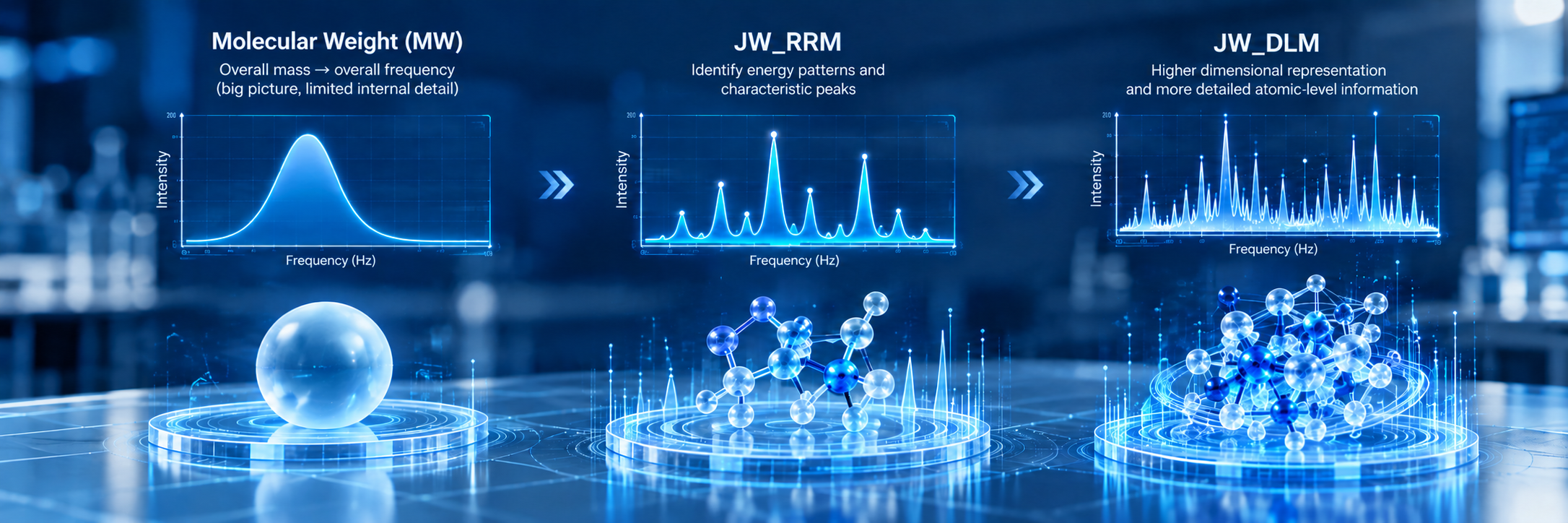
Differences Among MW, JW_RRM, and JW_DLM
John uses the descent of an aircraft as an analogy to explain the development from Molecular Weight to JW_RRM and then to JW_DLM.
At a high altitude, the overall contours of the ground and large structures can be seen, but individual details cannot be distinguished.
This represents the Molecular Weight method. It calculates a frequency from the overall mass of a substance. It provides a useful overall representation, but its ability to describe internal structure is limited.
As the aircraft descends, roads and vehicles become visible.
This represents RRM. The research moves beyond overall mass and begins to identify energy patterns and characteristic peaks.
As the aircraft descends further, buildings, vehicles, and the relationships among them become clearer.
This represents JW_DLM. By using a smaller averaging window, higher dimensional representation, and more detailed calculations, John’s model retains more information at the atomic level and attempts to define a substance at a higher resolution.
This analogy does not mean that the earlier methods have lost their value. Each stage adds another level of detail.
Molecular Weight provides the overall outline of a substance.
RRM begins to reveal its energy patterns and structural characteristics.
JW_DLM further increases the observational resolution and attempts to express finer characteristics of the substance together with its absolute frequencies.
Molecular Weight
Molecular Weight provides the overall outline of a substance.
JW_RRM
RRM begins to reveal its energy patterns and structural characteristics.
JW_DLM
JW_DLM further increases the observational resolution and attempts to express finer characteristics of the substance together with its absolute frequencies.
Current Project Status
Core Research Status
The core JW_DLM method has been established.
DLM frequencies have already been calculated.
The main JW_DLM research process is approaching completion.
Release Status
The method by which JW_DLM frequencies may eventually be provided to customers has not yet been decided.
Please stay tuned for future updates.